
🚖 Is The Number Of TAXI İn Istanbul Too Low Compared To World Cities?
04/08/2026
Is the Income of All Charging Providers Sufficient to Survive?
19/08/2026
📹 Did you know that your vehicle can record people and vehicles around it whenever you want?
👀 What about the fact that you can watch, download and share these images on other platforms?
🚗💥 What if your cameras recorded an accident or a major forensic incident that didn’t involve your vehicle?
⏳ That image may be a very valuable piece of evidence, but it may disappear on its own in the recording loop after a few hours?
🤔 But if all this is already possible, why do we use this technology only as a personal camera?
🔴 Why shouldn’t our vehicles also be “DIGITAL WITNESSES”?
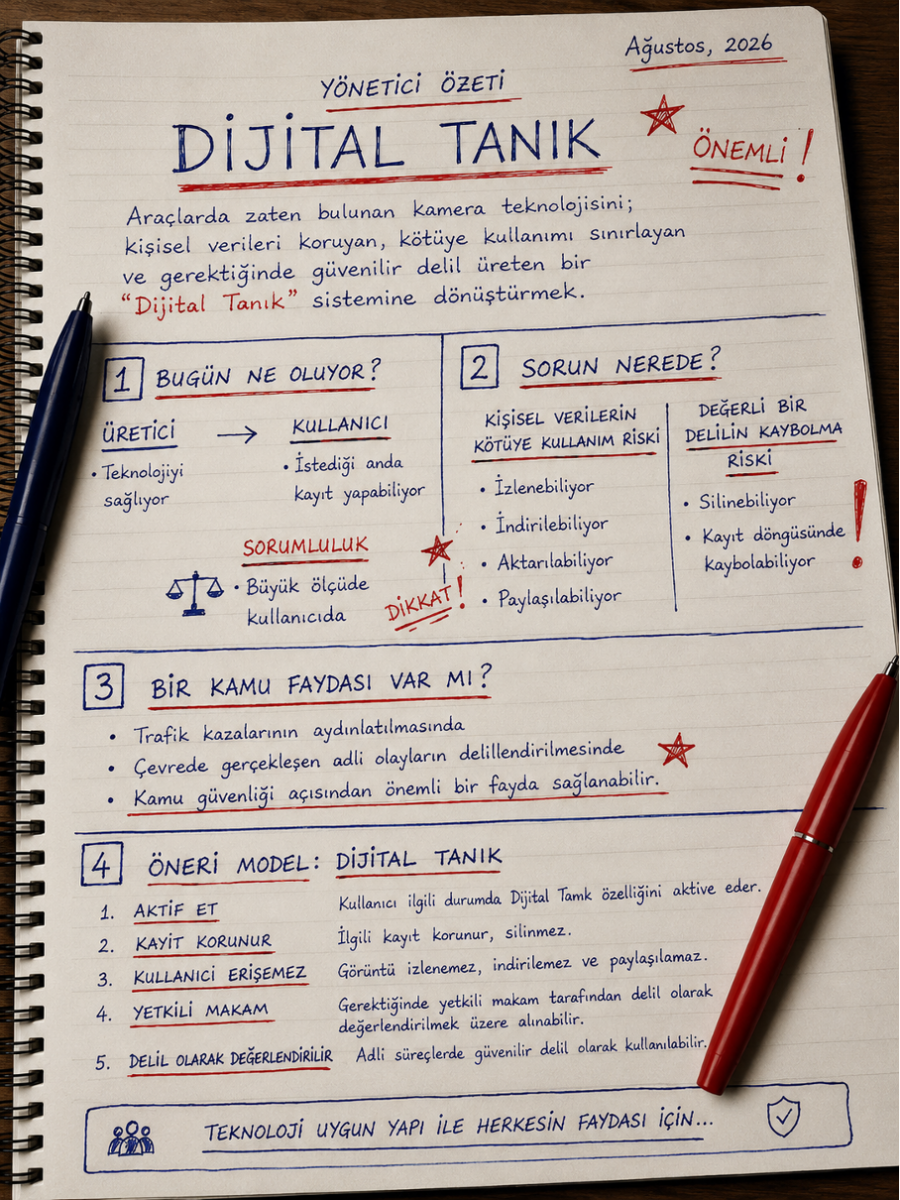
When I pursued these questions, the subject led me to four headings:
1️⃣ WHAT IS HAPPENING TODAY?
What do dash cams actually record?
2️⚠️WHERE’S THE PROBLEM?
What risks does the current user-controlled situation bring?
3️🏛️IS THERE A PUBLIC BENEFIT?
How can vehicle cameras on the roads turn into a “Digital Witness”?
4️💡SUGGESTION MODEL: DIGITAL WITNESS
Is it possible to have a model that preserves the image instead of sharing it?
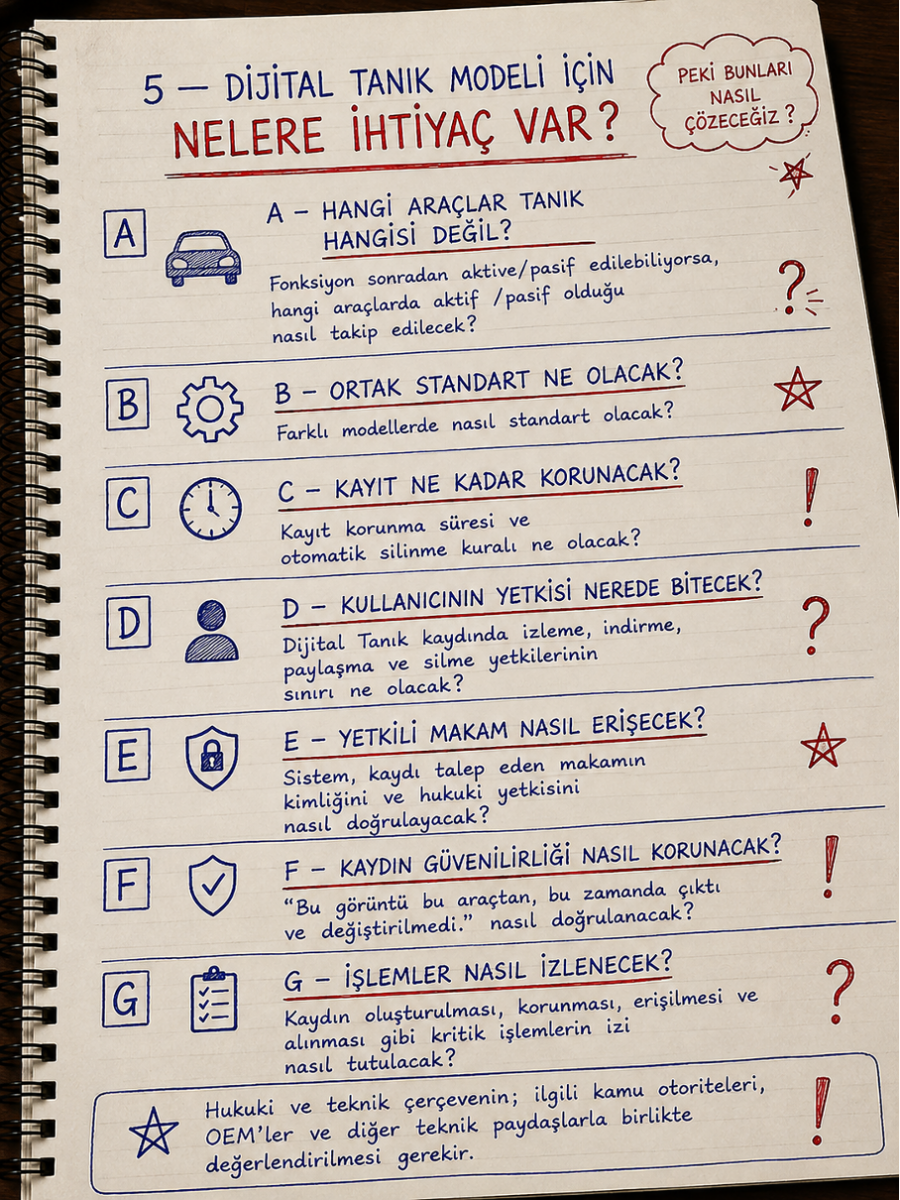
In the course of this work, I tried to put forward not only the current situation and possible public benefit, but also the difficult questions of the model I proposed, which need to be answered.
🚗 Which vehicles will be included in the system?
⚙️ How will the common standard be ensured?
⏱️ How long will the recording be protected?
👤 Where will the user’s authority end?
🔐 How will the competent authority access it?
🔏 How will the reliability of the recording be verified?
📝 How will transactions be monitored?
🎯 Because it is one thing to propose a model, but another to make it safe and applicable.
We are not responsible for how the solution will be implemented; relevant public authorities, OEMs and technical stakeholders should decide together.
📎 For those who want to examine the subject in more detail, I am sharing the study note consisting of 5 headings.
1 — CURRENT SITUATION
Is Recording Done with Dash Cameras at Any Time?
A. 📹 NOT JUST ACCIDENT RECORD
✅In some brands/models such as BMW, Mercedes-Benz, Tesla, Hyundai and Kia, the user can start recording at any time; the systems can record the surrounding scenery, road, traffic and people while driving with front/rear/side cameras.
❎In other words, contrary to popular belief, these cameras are not only used to record in the event of an accident, impact or theft.
B. 🔄 CAN THE RECORDING FEATURE BE ACTIVATED LATER?
✅Depending on the brand, model and market, the recording function can be offered as a standard, optional or retroactive, digital feature.
❎In other words, although the necessary camera and technical infrastructure are available in the vehicle, the recording feature may be turned off initially; It can be activated later by the user’s purchase of the feature or by a software update.
C. 💾 RECORD IS UNDER THE CONTROL OF THE USER, NOT PRODUCER (!)
In the applications we examined, images can be stored in the vehicle or on local storage media controlled by the user, rather than being kept in the “manufacturer’s central system”.
In some systems, the user can view, download or export the image.
D. ⚖️ LEGAL LIABILITY
Manufacturers can leave the responsibility for the use of the recording function in accordance with the personal data, video and audio recording rules in the country where it is located to the user.! ?️
2 — SYSTEM VULNERABILITIES
Where is the problem?
The technology can record, but how the recording is used, shared, deleted, and preserved as evidence when necessary is largely in the user’s control.
A. ⚖️ LEGAL RESPONSIBILITY IS LARGELY LEFT TO THE USER
With such powerful recording technology, is it enough to just say “comply with local legislation”?
With up to 6 camera recordings, the user takes significant responsibility for how the images of surrounding people, vehicles and events will be used!
B. 📲 WHAT HAPPENS AFTER RECORDING?
The user can view, download and export images.
In other words, the images recorded with the vehicle; It can be shared uncontrollably on WhatsApp, social media or other channels…
C. 🔄 CAN THE VEHICLE REGISTER LATER?
YES!
The necessary camera and technical infrastructure may be ready in the vehicle. The recording function can then be activated by software update, remote activation, or the user’s purchase of the digital feature.
In this case, even if the physical equipment of the vehicle does not change, the way of processing personal data changes.
D. 🗑️ CAN A RECORD WITH EVIDENTIARY VALUE BE LOST?
A valuable accident or incident image may have been recorded, but if the recording is under the user’s control, it may be deleted or automatically lost in the recording loop.
❎Dash cams usually record for a certain period of time and overwrite old images with new ones. If the user does not preserve an important image separately, a potential piece of evidence may disappear on its own after a certain period of time.
On ?️the other hand, even if the recording is preserved by the user, if the user is authorized to delete it, the existence and preservation of the evidence still depends on the user’s preference.
🔴If an image has evidentiary value, should its preservation be left solely to the discretion of the user?
3 — PUBLIC INTEREST
Maybe thousands of mobile dash cams are currently recording on the roads… How does this technology turn into a “digital witness”?
Digital testimony is not only about accidents involving the vehicle itself;
- Accidents in the surrounding area,
- Events that may have a forensic nature and
- It also expresses the potential to record social events.
Transforming this existing technology into a system that protects personal data and reduces misuse while producing reliable evidence when necessary can provide an important public benefit.
4 — RECOMMENDED MODEL: DIGITAL WITNESS
The Digital Witness button is pressed → The record is preserved and not deleted for a certain period of time → A record is created in the system → the user informs the competent authority if he/she wishes → If the authority detects that the vehicle has the Digital Witness system through the license plate, it can inquire whether it is registered or not → The competent authority takes the record with the necessary legal authority → The transaction is recorded in the system.
A. 👁️ TO PROTECT THE IMAGE, NOT TO SHARE IT
The driver uses the DIGITAL WITNESS function in an important event he witnesses.
This process ensures that the corresponding image is preserved for a certain period of time, which may be lost by being overwritten in the normal recording cycle.
When the Digital Witness is activated:
- ❌ Video cannotbe played
- ❌ Not Downloadable
- ❌ Cannot be transferred to USB
- ❌ Cannot be transferred to the phone
- ❌ Cannot be shared directly on social media
The user only sees the information: “Digital Witness Record Created — 14:32”.
Therefore, since the user cannot see the content of the image himself, he cannot make a claim based on the content of the image, such as “I have an image showing you running a red light”.
5 — REGULATIONS NEEDED FOR THE DIGITAL WITNESS MODEL
In order for the Digital Witness model to be implemented, the following issues must be legally and technically defined by the relevant public authorities. The determination of the method and technology to be applied should be in the evaluation of the public authority.
A. 🚗 IT SHOULD BE KNOWN WHICH VEHICLES ARE DIGITAL WITNESSES
The authority should be able to determine which vehicles have the Digital Witness function active.
The function can come with the vehicle or be activated later with a software update, digital purchase or remote activation.
Therefore, it should be defined between the OEM-distributor-authority how this change will be notified and kept up to date.
B. 🔴 “DIGITAL WITNESS” FUNCTION SHOULD BE STANDARDIZED
When it comes to “Digital Witness”, basically the same protection principles must be applied in all these systematic tools.
Basic features such as which image will be preserved, how much before and after the event will be recorded when the function is activated, which cameras will be used and the recording time should be determined.
Different brands use different working logics, making it difficult for the public to create a common and reliable Digital Witness system.
C. ⏱️ REGISTRATION AND STORAGE PERIODS SHOULD BE DETERMINED
A balance should be struck between not losing evidence and not having a continuous image archive in citizens’ vehicles.
For example, in the model:
- 6-hour loop → normal recording
- A structure such as +24/48 hour protection → Digital Witness can be considered.
However, what these periods should be should be determined by the public authority as a result of legal, technical and operational evaluations.
D. 👤 USER’S AUTHORITY ON THE RECORD SHOULD BE DEFINED
The preservation of the Digital Witness record should not give the user unlimited disposition over the image.
Especially the user; the limits of monitoring, downloading, copying, transferring to USB/phone, sharing and deleting authorizations should be determined.
Images protected as Digital Witnesses should be considered to be kept in a different access status than the user’s normal camera recordings.
E. 🔐 AUTHORIZED ACCESS AND VERIFICATION
A standard mechanism should be established for who can access Digital Witness records and under what conditions, and where the identity and legal authority of the authority requesting access can be securely verified by the tool.
The relevant public authorities should determine in which cases a police request will be sufficient, and in which cases a prosecutor/judge decision or other legal authorization will be required.
F. 🔏 THE INTEGRITY OF THE EVIDENCE OF THE RECORDING SHOULD BE GUARANTEED
It should be possible to say that “this image really came out of this vehicle, on this date and has not been changed.”
Necessary standards should be established to associate the Digital Witness record with the date/time, vehicle and recording source and to verify whether the image has been altered later.
Otherwise, even if the image is available, the reliability of the evidence may become questionable.
G. 📝 EVERY TRANSACTION SHOULD BE TRACED
Critical operations performed on the Digital Witness record should be auditable afterwards.
For example:
Digital Witness created → Protected → Access requested → Authorization verified → Record retrieved → Record deleted
The principles for recording critical transactions such as these should be determined.
Here, it should be distinguished between sending the image itself to a central system and keeping only the information that “a Digital Witness record has been created”.
H. 🗑️ THERE SHOULD BE A RULE OF DISPOSAL AFTER STORAGE
Images should not be stored indefinitely on the grounds that “maybe they will be needed in the future”.
Principles should be established for the automatic deletion of Digital Witness records that are not taken under judicial protection within the specified period. How long the image transferred to the competent authority will be stored and when it will be destroyed should be determined within the scope of the relevant legal process.